Commercial Property Inspection Services
Strategic Risk Management for Investors, Tenants, and Owners
Commercial real estate transactions are complex, involving high stakes and significant liability. Whether you are purchasing a retail strip, leasing a warehouse, or managing an office building, understanding the physical condition of the asset is crucial for your bottom line.
Our Commercial Property Inspections adhere to the ASTM E2018-15 Standard Guide for Property Condition Assessments (PCA). We provide a comprehensive analysis of the building's major systems to help you forecast maintenance costs, negotiate fairly, and limit liability.
Types of Commercial Inspections We Offer
1. Pre-Purchase Commercial Inspections (Due Diligence)
Know the Asset Before You Buy
Designed for investors and business owners purchasing a property. This is a top-to-bottom assessment of the building's current condition and projected lifespan.
Who it’s for: Investors, REITs, Owner-Users.
The Goal: To identify "deal-killers," estimate Immediate Repair Costs, and forecast capital expenditures (CapEx) for the next 5-10 years.
2. Triple Net Lease (NNN) Inspections
Protect Your Interests as a Lessee
In a Triple Net Lease, the tenant is often responsible for building maintenance, insurance, and taxes. Before signing a long-term lease, you must know if you are inheriting a failing HVAC system or a leaky roof.
Who it’s for: Prospective tenants entering a NNN lease.
The Goal: To document the property's condition before you take possession, preventing you from paying for pre-existing defects.
3. Pre-Listing Commercial Inspections
Streamline the Sale Process
Prepare your property for the market by identifying deferred maintenance that could stall a sale or result in a price reduction.
Who it’s for: Sellers, Property Managers, Brokers.
The Goal: To fix issues proactively or disclose them upfront to justify the asking price and smooth out the due diligence period.
4. Construction Progress Monitoring (Draw Inspections)
Verify Commercial Build-Outs
For new commercial construction or major tenant improvements (TI), we act as the eyes of the lender or owner. We verify that the work completed matches the funds requested by the contractor.
Who it’s for: Lenders, Developers, Absentee Owners.
The Goal: To ensure the project is on schedule and funds are being released only for completed work.
What is Included in a Commercial Inspection?
We evaluate the "Five Major Systems" critical to commercial assets, along with safety and accessibility features.
1. The Building Envelope & Structure
We inspect the foundation, structural framing, exterior walls, curtain walls, parking decks, and roofing systems (flat, membrane, built-up). We look for water intrusion, structural failure, and pavement degradation.
2. HVAC Systems (Heating, Ventilation & Cooling)
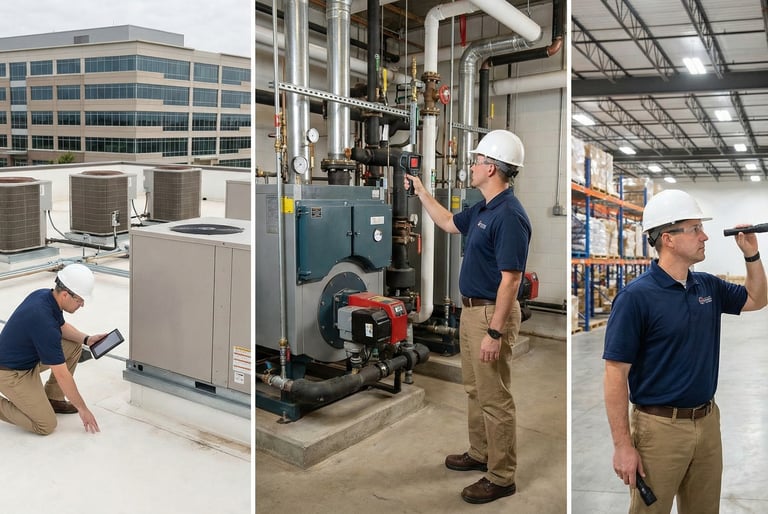
Commercial HVAC replacement is a massive capital expense. We inspect RTUs (Roof Top Units), chillers, boilers, and cooling towers to determine age, condition, and estimated remaining service life.
3. Electrical Systems
We assess the main service panels, transformers, and distribution wiring. We check for capacity issues, outdated wiring (aluminum), and safety hazards that could violate fire codes or insurance requirements.
4. Plumbing & Life Safety
Shutterstock
We inspect domestic water supply, waste piping, water heaters, and critical safety systems including fire sprinklers, alarms, and emergency lighting.
5. Interior Elements & ADA Accessibility
We review interior finishes (flooring, ceilings, walls) and conduct a limited visual review of accessibility compliance (ramps, bathrooms, parking) to highlight potential ADA liabilities.
FAQ
Q: How is a commercial inspection different from a residential home inspection?
A: While both inspections look for defects, the scope and standards are very different. A residential inspection focuses on the safety and function for a family living in the home. A commercial inspection (Property Condition Assessment) focuses on financial risk and liability. We analyze the life expectancy of major systems (like commercial HVAC units and flat roofs) to help you forecast long-term capital expenditures (CapEx) and return on investment (ROI).
Q: How much does a commercial inspection cost?
A: Commercial inspection costs vary significantly based on the type of building (e.g., warehouse vs. medical office), total square footage, and the complexity of the mechanical systems. We provide custom proposals for every project. Please contact us for a quote based on your specific property details.
Q: Do you inspect for ADA (Americans with Disabilities Act) compliance?
A: We perform a visual review of accessibility features as part of our standard inspection (checking parking spaces, ramps, and bathroom access). However, a full, technical ADA audit is a specialized service that requires a separate, detailed survey. If you require a certified ADA audit, we can discuss adding this to your scope of work.
Q: Can I attend the inspection?
A: Yes, we encourage you to attend, particularly towards the end of the inspection. This allows our lead inspector to walk you through the most critical findings on-site. However, because commercial inspections can take several hours or even days, most clients choose not to be present for the entire duration.
Q: How long does it take to get the report?
A: Due to the complexity of commercial properties, the report takes longer to generate than a residential report. You can typically expect the full Property Condition Report (PCR) within 2 to 3 business days following the inspection. We can often provide a verbal summary of major "deal-killers" immediately after the walkthrough.
Q: Do you check the fire sprinklers and alarms?
A: We visually inspect the condition of sprinkler heads, pipes, and alarm panels to ensure they are present and appear functional. However, we do not perform the annual technical testing or "tagging" of these systems, which must be done by a licensed fire protection company. We will review the existing maintenance tags to verify if the systems are current on their testing.
Q: What happens if you find a major problem?
A: Our job is to give you the facts. If we find a major structural or mechanical failure, we will document it clearly in the report with photos and, where possible, provide context on the severity. This information allows you to re-negotiate the purchase price, request repairs, or walk away from a bad investment.
Inspection Services:
Pre Purchase Inspections (For Buyers Commercial And Residential )
Wind Mitigation Inspection (For Insurance )
4 Points Inspections (For Insurance )
Roof Condition Certification (For Insurance )
Building Plan with dimensions
Pre Drywall Inspection ( New Construction Commercial And Residential )
Pre Listing Inspection ( For Seller Commercial And Residential )
Pool Inspection
Sewer Scope Inspection
Lead Paint Inspection
Mold Inspection
WDO - We Schedule with our sister company
Contact
321-222-3116
© 2025. All rights reserved.
Address: 336 Wilshire BLVD Suite 274-229 Casselberry FL 32707
Blog Post List
Central Florida 11-Month Inspection: The 10 Most Common Hidden Defects in New Construction Homes
How a Home Inspection Helps You Avoid Expensive Surprises After Closing in Central Florida
Common Problems in Homes Built in the 60s and How to Mitigate Them
Commercial Property Inspections Are Essential—Don’t Buy Without One
Winter Park, Florida Real Estate: A Hot Market with Timeless Charm — Powered by QRESLLC.com
Understanding PEX Piping: A Comparison of Pre-2010 and Post-2010 Installations
High-Risk Discovery: Why the Challenger Electrical Panel is a Major Red Flag on Your Home Inspection
Time Bomb Plumbing? Why Buyers Need a Home Inspection to Spot Polybutylene Pipes ⚠️
Secure Your Investment: Why Property Inspections are Non-Negotiable Before You Buy 🏡🏢
Hidden Fire Risk: Why Your Home Inspector Must Check for Single-Strand Aluminum Wiring 🔥
Clay Tile Roof: The Buyer's Guide to Lifespan, Maintenance, and Home Inspection Red Flags
Mastering the Art of Negotiating Property Prices in Central Florida
Tile Trouble: The Hidden Problems of Installing Solar Panels on Clay Roofs 🧱⚡
A Homeowner’s Guide to Roofing in Florida: Lifespan, Insurability & Maintenance
Understanding Electrical Wiring in Florida Homes: Old vs. New and What It Means for Insurance
The Hidden Hazard: Cast-Iron Sewer Piping in Central Florida
VA Mortgage Loan: Qualifications, Steps, and Expert Insights for Homebuyers
Living in Orlando ZIP Code 32828: Neighborhood Guide, Schools, Home Types & Common Building Issues
Living in Zip Code 32792: A Complete Guide to Winter Park’s Vibrant Community
Living in Oviedo, Florida (32765, 32766, 32762): A Complete Guide for Homebuyers and Residents
Owning a Piece of Florida History: Key Challenges and Mitigation for 1960s Central Florida Homes
🐜 The Silent Destroyers: A Central Florida Homeowner’s Guide to Termites
🏙️ Living in 32801: The Pros and Cons of Downtown Orlando Life
Living in 32102: The Realities of River Life in Astor, Florida
🌿 Discovering the Hidden Gem: Life, Land, and Real Estate in Zip Code 34739
🌪️ Wind Mitigation Inspection in Florida: Your Key to Safety & Insurance Savings
The 4-Point Inspection: Your Ticket to Florida Home Insurance
🌿 The Silent Intruder: Why Professional Mold Testing is Critical for Your Florida Home
🏡 Navigating the 32777 Housing Market: Why Expert Home Inspections are Essential in Casselberry, FL